
The work from an Architecture degree.
01
D E S I G N


P E R I O D R O O M


Light and Water
Four fixed solar tubes bring natural light into rooms based on the sun’s position- waking the inhabitant in the morning and illuminating high-energy spaces like the kitchen and office throughout the day. A fifth, flexible tube can be redirected between the bathroom, living room, and laundry, but only lights one room at a time, encouraging mindful, adaptable use.
The period room uses collected rainwater, which is filtered, manually pumped, and recycled. Exposed tubing reveals the flow from unfiltered to filtered water, showing usage and encouraging awareness. A gravity-based tipping bucket and natural rainfall act as timers, limiting how much water can circulate at once.
UG4 Wallenberg Studio
March 2025
Group
Ryan Ball
Time once followed the rhythms of nature- sunlight, seasons, tides- guiding the lives of plants, animals, and humans alike. Industrial systems broke that connection, replacing natural cycles with structures built around productivity and consumption. But time remains beyond our control, and detaching from it comes at a cost.
In a post-comfort world, people begin to realign with solar time and water cycles, trading digital dependencies for analog tools. It’s not regression, but a return to slower, more intentional living- where time belongs to nature, not the clock.
This room is a self-contained living space powered by sunlight and rainwater. It supports a life shaped by natural rhythms, encouraging awareness, balance, and quiet adaptation to the cycles that sustain us.


Views from the Peep Holes


Process


A G Y M N A S T ' S F I E L D H O U S E

UG2 Design Studio
April 2024
Independent
Jono Sturt
What if watching a sport wasn’t just about sitting still, but about moving with it? How does what we see change what we understand? What do we miss when we only see from one point of view?
This project is about spectatorship. About designing not just for what happens on the floor, but for the act of witnessing itself.
Gymnastics is a sport of extremes- high and low, fast and still. This project mirrors that, unfolding its spaces like a performance. It invites viewers to move, to see from more than one angle. It turns observation into a journey- not just watching, but discovering.
Here, architecture doesn't just hold the sport. It becomes part of how the story is told.

As you step closer, more about this sport is revealed.
From gymnast to coach to casual viewer, each role sees the sport from a different place- and that difference matters. In various ways, these zones unfold: tucked-away training spaces for gymnasts, elevated lounges for spectators, transition stairs for slowing down, and exterior terraces that offer a distant, almost cinematic view. The building shapes how each person witnesses it, shown in the following floor plan.

The section that lets you look into the fieldhouse zoning vertically and in hierarchy- from the sunken gymnasium to the outdoor seating, this project emphasizes spectatorship from all levels.

The following images are best viewed with 3D glasses.

What does it mean to really see something, and how much does the way we see shape what we understand? These renderings use stereoscopic anaglyphs to create a layered, slightly surreal view of the building through red and blue filters.
With 3D glasses, depth flickers into place, enhancing the points of viewership one would experience approaching and experiencing this fieldhouse. It’s a reminder that spectatorship isn’t static; it shifts, reveals, and sometimes pops out at you when you least expect it.

Exterior

Exterior-Interior

Interior
Process


P R O J E C T H U G

Architecture doesn't have to be something you walk into, so here's an example of how to wear it.
This project explores that question through an accordion-folded apparatus that connects two bodies. As they move apart, it stretches to reveal a delicate rhythm of perforations and folds; when they come together, it contracts into a sharp, singular form. It’s a simple play on movement, tension, and the space a body takes up- or leaves behind.
ARCH 253 SCALE
October 2022
Group
Zain AbuSeir
Long Exposure


Studies
A
B


C O P Y
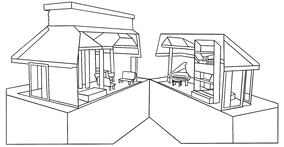
COPY is a deep dive into the world of the Charles Moore Orinda House- a place where a home refuses to behave like one. This study explores Moore’s offbeat spatial language: rooms framed like shrines (aediculae), walls that slide away or don’t exist at all, and a sunken bathroom that feels more like a secret retreat than a utility space. Nothing in the house is arranged conventionally, yet everything has a logic- one that values experience over order. This project encapsulates and makes sense of the Orinda's playful complexity, capturing how Moore turned a simple home into a collage of space, light, and movement. It’s part homage, part blueprint for future experiments in bending the rules.
Section A highlights the sculptural presence of the aediculae, revealing how they frame space above while program unfolds below. It captures the house’s layered openness- walls that slip, shift, or vanish- and the unevenness of floors and volumes that define Moore’s spatial logic.
Section B reveals the shifting alignment of the aediculae and offers a glimpse into the structural rhythm of the house. It frames the contrast between public and private spaces, showing how the more enclosed kitchen tucks away from the open, shared zones—quietly reinforcing the home's layered spatial hierarchy.
UG1 Design Studio
October 2023
Group
Anca Trandafirescu

U N W R A P
UG1 Design Studio
November 2023
Independent
Anca Trandafirescu
This project takes the unconventionality of Charles Moore’s Orinda House and runs it through a series of abstract study models. It starts with the basics: playing with the scale of the aediculae, testing out how big and small spaces interact in the house. Then it moves into the push and pull of open vs. closed- those boundaries between public and private, whether taken from the sliding doors or the kitchen and closet section vs. living room and bathroom section. Eventually, the roof gets involved too, adding a more familiar form of the original house to the model. All of this exploration leads to a final model made from one continuous plane that loops and folds around itself, capturing the layered logic of Orinda in a simplified, sculptural way. It quietly asks: how much of a house’s character can you keep when you strip everything else away? Not a replica, not a monument- just a thoughtful reinterpretation, told through shape, space, and a few folds.


_edited.png)
Studies
Public vs. Private space
Large and small space
Exploration of service vs. open area alongside large and small space
Addition of roof and aediculae geometry
Framing study
Cladded frame to show movement, highlight certain areas, and establish final modeling method

F I L L I N T H E B L A N K


Fill in the Blank is a modular design exercise that explores how small, repeatable parts can come together to form something greater than the sum of their moves. This project centers around a single unit- a "brick"- designed through an iterative process where each version explores a different pattern or structural idea. The final brick captures this evolution, holding traces of multiple design intentions in one compact form. When assembled into a wall, these bricks interact in complex ways: sometimes aligning, sometimes offsetting, always revealing something about the unit itself. The wall becomes not just a surface, but a system- one that adapts to different configurations and invites variation. In this project, the design isn’t about closing space off- it’s about offering space for interpretation, repetition, and playful assembly.
How this design was developed
Wall Configurations
ARCH 257 Assembly
April 2023
Charlie O'Geene

L O C K A N D K E Y


This project explores the structure and logic of a Hanayama puzzle- something to solve while also being a sequence to understand and model. The project takes the puzzle apart step by step, translating each move into separate physical representations. Through careful analysis and modeling, the process reveals how the pieces interact through sliding and rotation. Rather than focusing on the object itself, the project highlights the choreography of disassembly and reassembly, turning a quiet mental challenge into a study of sequence, interaction, and precision. Lock and Key becomes both an instruction manual and a reflection on how parts connect, come apart, and eventually find their way back together.
ARCH 254 PROJECTION
December 2022
Zain AbuSeir
.png)
L O C K A N D K E Y


ARCH 254 PROJECTION
December 2022
Independent
Zain AbuSeir
This project explores the structure and logic of a Hanayama puzzle- something to solve while also being a sequence to understand and model. The project takes the puzzle apart step by step, translating each move into separate physical representations. Through careful analysis and modeling, the process reveals how the pieces interact through sliding and rotation. Rather than focusing on the object itself, the project highlights the choreography of disassembly and reassembly, turning a quiet mental challenge into a study of sequence, interaction, and precision. Lock and Key becomes both an instruction manual and a reflection on how parts connect, come apart, and eventually find their way back together.


A L L O U T O F O N E T H I N G
It starts on the ground and just keeps going. A continuous wooden surface, folding and curving its way upward- never quite a ramp, never quite a roof, but something in between. There are no stairs. No edges where one thing becomes another. Just one material, one gesture, doing everything at once: holding itself up, giving people a way to move, to stand, to climb without thinking about it.
In the way it leans, it feels less like something built and more like something grown. A structure that doesn’t separate use from form, or form from feeling. It’s all connected. All made out of one thing.
UG3 Design Studio
October 2024
Craig Borum
Basswood Model


How the ramps come together


Plan
Section

S T R U C T U R E D

The Bridge Project
Our task: design a bridge using only wood and glue, under 4 ounces, 30 inches long, and strong enough to hold 50 pounds. We chose a simple truss made of basswood for its lightness, with a deck and horizontal connectors to add stability without extra weight.
We analyzed which members were in tension and compression, refining our design from concept to final form. The result was a bridge that balanced strength, simplicity, and just enough overthinking to keep it standing.


Bridge Height: 5.5"
Bridge Weight: 3.84 oz
Weight Held: 70 lbs
Mode of Failure: Weakened Joints
Total Members: 42

Horizontal Connecting Members

Deck
Compression
Tension
ARCH 324 Structures
December 2024
Group
Peter van Buelow
The Tower Project


Tower Height: 48"
Tower Weight: 3.86 oz
Total Weight Held: 240 lbs
Mode of Failure: Joint Failure
Number of Members: 84
Building something tall and delicate that’s also strong is always a bit of a paradox- especially when the rules say it has to be 48 inches high, weigh less than 4 ounces, and hold 50 pounds. With only wood and glue at our disposal, we leaned into the fundamentals of column behavior, especially how and why things buckle.
To outsmart buckling, we broke up the height with diagonal bracing, vertical supports, and horizontal connectors- interrupting long, flimsy lengths before they had the chance to give up. Every piece of the design was there to shorten the effective length of something else.
The result looked simple, but was anything but. It stood because the load was shared, the members were smartly arranged, and every inch was doing its part- not bad for four ounces of wood and some glue.
Armed with pens, layers, and just enough collective sleep, our group tackled a construction drawing set for a slice of a single-family home. We produced a plan, elevation, and wall section- carefully aligning lines, dimensions, and details to speak the language of builders.
Every hatch, note, and break line was a method of translating design into instruction. It was less about big ideas, more about how the wall actually meets the floor- and what keeps the rain out.
The Construction Document

ARCH 324 Structures
April 2025
Group
Peter van Buelow
ARCH 317 Construction
December 2023
Group
Craig Borum